

Mt Ngāuruhoe stands as a striking, 2,291-meter volcanic icon within the heart of Tongariro National Park, but its popularity has come at a cost to both its physical slopes and its spiritual significance.
While the heavily scared northern “trade route” is now strongly discouraged by DOC and local iwi, the southern flank offers a “path less trodden” through blocky ‘a‘ā lava.
This 12-hour return journey allows experienced hikers to witness the raw power of the Taupō Volcanic Zone without leaving a footprint on the mountain’s northern scoria.
By navigating the more difficult southern terrain and choosing to stop at the crater rim rather than the sacred summit, you can experience the mountain’s geological majesty while honoring the cultural mana of Ngāti Tūwharetoa.

Mt Ngāuruhoe from the South Side: The Path Less Trodden
Mt Ngāuruhoe (2,291m) is the second-highest peak in Tongariro National Park, and depending on how you are feeling, it is either a perfectly formed volcanic icon or a humungous pile of chunderous rock.
At 7,000 years old, Ngāuruhoe is a “parasitic” youngster compared to his 250,000-year-old warrior father, Tongariro. But in the Māori world, age is secondary to presence. These peaks are the realm of Ranginui (the Sky Father), and for the people of Ngāti Tūwharetoa, the summit is the head of an ancient ancestor—sacred, or tapu.
When Ngatoroirangi the navigator of Te Arawa and a powerful tohunga was ascending Tongariro (Ngāuruhoe) to make his claim to the surrounding lands on behalf of his people he was overcome by a violent storm and desperately called on his priestess sisters in prayer for warmth. They responded with fire at the volcano’s summit, and in appreciation Ngatoroirangi sacrificed one of his slaves Aurohoe. The mountain is considered to be named after this unfortunate fellow.
Currently, both DOC and local iwi discourage climbing Ngāuruhoe, but rely on voluntary compliance only and have no compulsory prohibition. Their stance is rooted in the physical “scarring” of the northern scoria slopes by thousands of boots, and the spiritual intrusion on the summit.

The Geological Reality
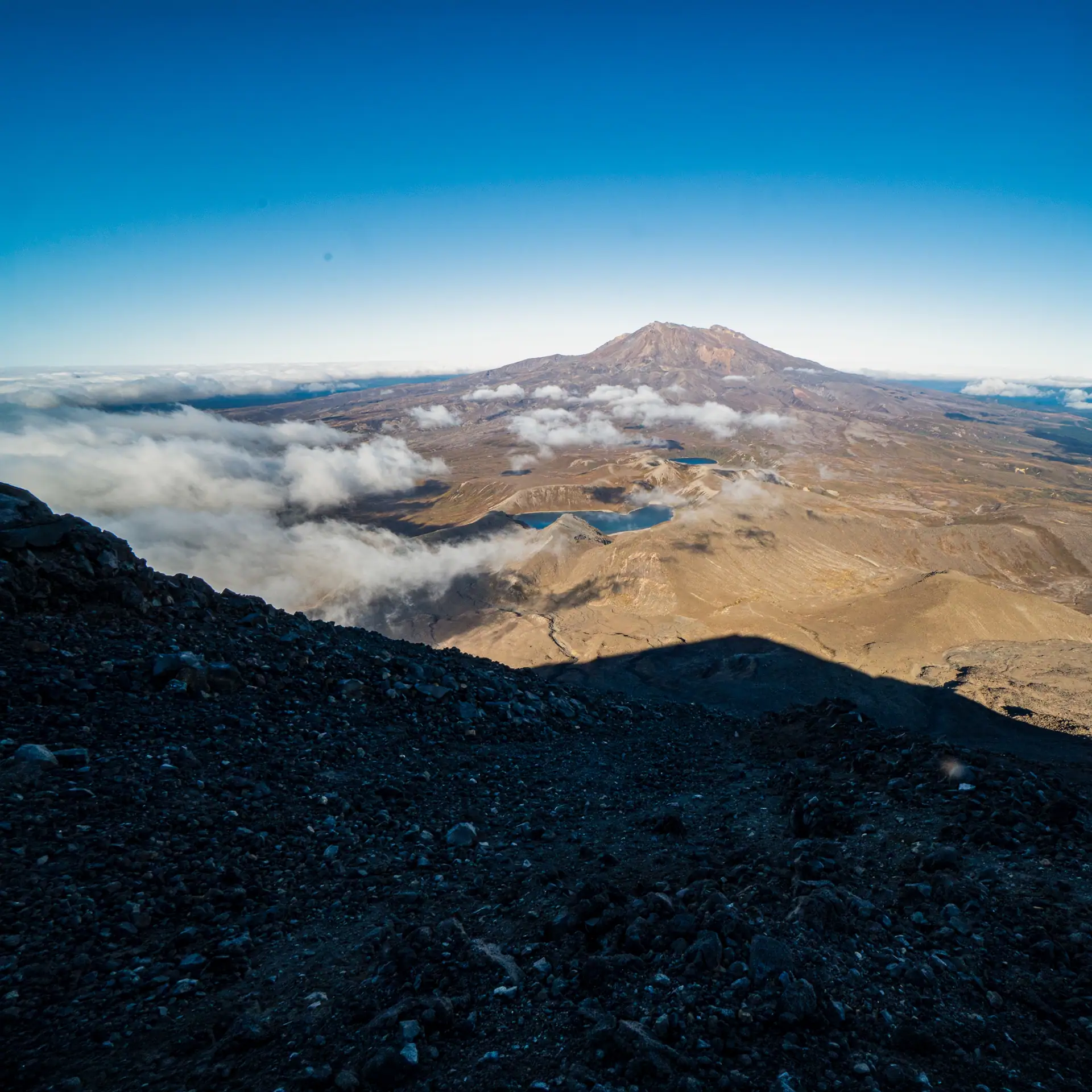
However, there is another perspective—one dictated by the raw, indifferent power of the Earth itself. On a fine day, the view from the upper slopes of Ngāuruhoe is of a volcanic wonderland, at once serene and full of malice. Steam from active fumaroles serves as a constant reminder that the Earth’s crust in the Taupō Volcanic Zone is some of the thinnest on the planet.
Ultimately, the mountain is a massive, pressurized engine powered by molten magma not far below the surface. It operates on a scale of deep time where human history—and our various narratives of kings, warriors, and guardians—is just a brief flicker.
Whether one views the peak as tapu or as a geological hazard, the reality is the same: the mountain will eventually erupt again, resetting the landscape and reminding us that we are merely guests on its surface.
The Case for the South Side
While the “trade route” on the northern face suffers from mass-use erosion, the southern flank is a different world. Here, the mountain is guarded by blocky ‘a’ā lava—sharp-edged, essentially immovable, and notoriously difficult travel. Having explored this side of the mountain for over 40 years, I can attest that it is almost impossible to leave a footprint in this lava. By approaching from the south, the “mass-use” problem vanishes. There are no crowds, no tracks, and no ecological scarring.
A Matter of Respectful Distance
Navigating the cultural landscape is, for some, a matter of “Good Manners” rather than religious compliance. Many modern climbers choose to stop their ascent at the crater rim, rather than standing on the absolute highest point (although the actual highest point of Ngāuruhoe is difficult to decide—and it changes with each eruption). By intentionally stopping short of the actual summit, you acknowledge the mana of the mountain and the requests of its traditional guardians while still experiencing the raw power of the volcanic environment.

The Journey
To experience this version of the mountain, start at the Tama Lakes track behind the Chateau. From the Upper Tama viewpoint, leave the crowds behind, navigate the ridge directly toward the peak and keep walking. It is about a 12-hour return trip.
Note: The southern slopes are mostly ‘a’ā type lava that can be rather brutal. It will shred lightweight boots and skin with ease; sturdy footwear (and maybe gloves) for the scramble is highly recommended. And coming down is mostly more difficult than climbing up.
By choosing the difficult southern path and the humility to stay off the highest point of the rim, you aren’t just “sneaking” a climb—you are engaging with Ngāuruhoe on its own terms: with effort, silence, respect, and a healthy dose of geological perspective.