
If you are planning a trip to Totara Flats Hut in the Tararua Range, you have likely seen the alert for the Lower Waiohine Track. DOC notes that there is no longer access to pass above a large active slip about 1 km downstream from the flats. They claim that the only access past the slip to Totara Flats Hut now requires walking upstream on the riverbank, and that this will be impassable during high river flows. Because DOC warnings are generally conservative, I decided to head in and investigate the slip firsthand. If you are weighing the Holdsworth route against the Lower Waiohine Totara Flats Track, here is my on-the-ground findings on what you will actually face.
Totara Flats Lower Waiohine Track
There are two main tracks into Totara Flats in the Tararua Range: from Mt Holdsworth Road, and the Waiohine Gorge Road. DOC gives the walking time to Totara Flats Hut from Holdsworth as 5 to 6 hours, and from Waiohine Gorge as 4½ hours.
The Holdsworth route climbs 500 m up the Gentle Anne Track on an easy, well-formed track, before dropping 600 m reasonably steeply in places on a well-marked and maintained tramping track. The Holdsworth route is regarded as all-weather track with bridges over all side streams
The Waiohine track follows the river all the way to the hut with only short climbs, but the track can be muddy and slow in places. However, the Waiohine route passes under an active slip about 1 km downstream from the flats, and this can cause problems during or after heavy rain.
In fine weather and with a normal river flow this slip is easily passed by simply walking for approximately 100 m along the riverbank. However, with high water levels after heavy rain the riverbank will be underwater and impassable.
Until late 2024 there was a marked tracked that climbed mostly above the slip—and while annoying and requiring extra time it did provide a reliable means to bypass the riverbank section and so provide a way past the slip.
But as at June 2026 there is a DOC alert for the track that states this bypass track is now inaccessible, which means the Lower Waiohine route to Totara Flats will be impassible during or after heavy rain when the river is flowing at a high level. Given that DOC is often (understandingly) conservative with its warnings I decided in March 2026 to go and take a look at the slip for myself and the following is what I discovered.
Getting personal with the Lower Waiohine Totara Flats Track slip
I walked into Totara Flats via the Holdsworth Track (my preference, even if longer than the Lower Waiohine Track, simply because there is more variety in the possible views available) and continued down the flats to the slip.


Walking along the riverbank under the slip to the downstream side was very straightforward even without a marked trail. Looking up at the slip gave me the impression that the scarp crest was unstable and recently active, and perhaps loitering on the riverbank would not be a particularly sensible idea.
I expected that the orange triangles marking the bypass track would have been removed by DOC and this seemed to be the case. However, with some sleuthing I found the downstream beginning (Waiohine Gorge side) of the track and followed it uphill, noticing that only the uphill triangles had been removed for about 100 m while beyond this all the markers were still in place.
I decided to follow the track and just see where it took me and why it was now deemed impassible.
Following the markers was relatively easy to begin with. It was an easy climb to gain 100m of height above the track. After this the track sidled across a small gully where there was a lot of treefall that slowed me down – climbing over and under the large trees before I got ensnared in dense supplejack vines that took a long time to untangle myself from. It was slow and very frustrating. I lost the markers after this but suspect the original bypass track had climbed higher around the edge of the slip before sidling across as I could still see a couple of track markers on posts, completely askew and clearly not marking any sensible trail now.

I was about 50 m below the top of the scarp and there were obvious signs of fairly recent rock slides. I believe the slip has increased in height since the map was last updated and has swallowed up more of the hill since then.
I dropped down to the 260m contour line and crossed the slip there. It was easy enough to get onto the slip. Navigating across the slip required a bit of care as it could be easy to slide on it (mindful that the scarp crest looked even more unstable this close up) and I wouldn’t recommend it for inexperienced trampers, particularly in wet weather.
After climbing off the slip, I easily found markers on the other side amongst some toetoe grass. Again, there was more supplejack that required a great deal of patience before I started descending back to the river on a relatively easy and well-marked track. I did notice that there is still a track marker on a tree to indicate the start of the bypass track at the Totara Flats end, but it is easy to miss as it is faded and covered by moss so would likely only be found by anyone really looking for it.

So, clearly it was still possible to bypass a flooded riverbank and get past the slip—but would it be sensible on a tramping trip, in the rain with a flooded river, either by going my route, or climbing completely above the slip?
And my answer is NO to both.
- My route was okay in fine weather—but during or after rain the slip appeared to me to offer the very real risk of rockfall (as also noted by DOC) and not worth taking the chance. I would allow 1.5-2 hours for the route I took.
- Climbing completely above the slip—but this would be pushing an average tramping party to the limits given the difficulty I had bashing through a relatively short section of untracked bush, and my estimate is that it would add another 2-3 hours to the time to the hut.
So, I agree with DOC’s warning that there is now no access to safely pass the slip when the river is covering the riverbank—unless perhaps you are a hardcore Tararua tramper prepared to bushbash completely above the top of the slip.
The logical alternative to battling with the slip during or after heavy rain when the Waiohine River may be flowing over the riverbank is to simply use the all-weather Holdsworth route, or if you are already heading to or from the flats via the Waiohine Track then turn around.
Let me know your thoughts in the comments.
River flow vs rainfall
Data on flows, stage, and rainfall for most significant NZ rivers are readily available on the web.
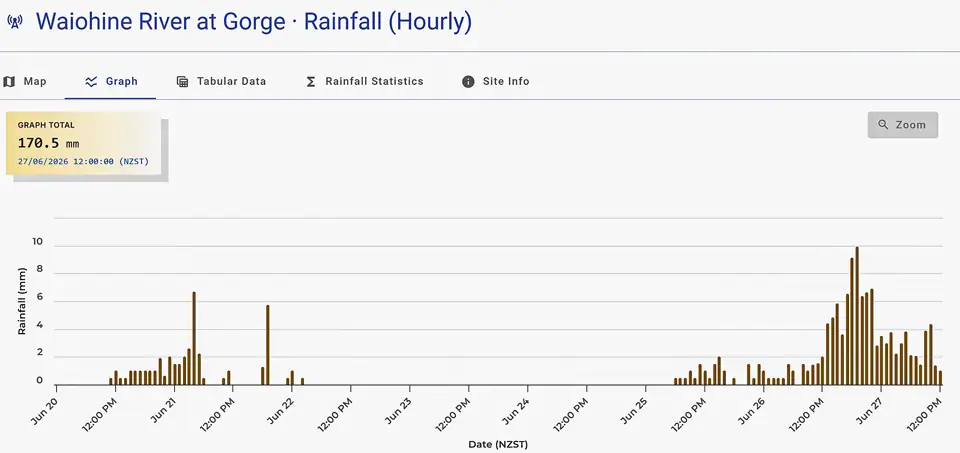
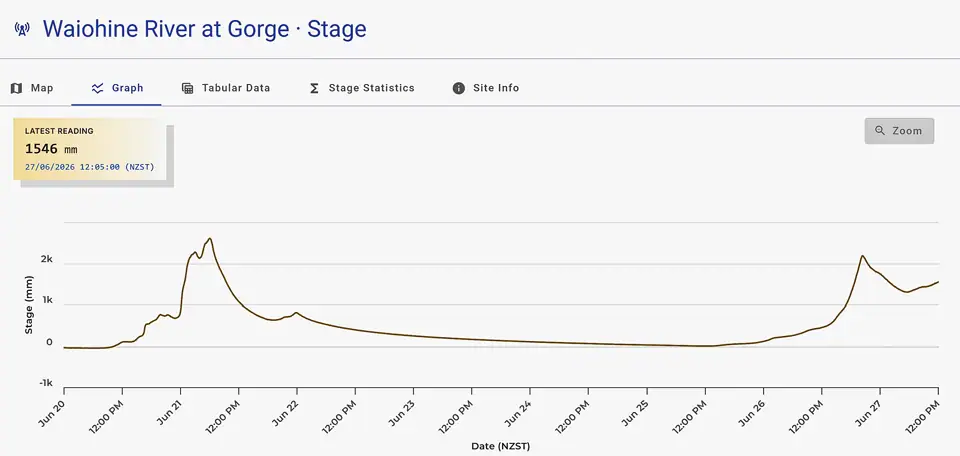
Data for the Waiohine River at the Gorge Bridge, while not directly at the track slip, give a valuable view on the river’s behaviour during heavy rain.
Firstly, the flow in the river follows the intensity of the rain but lags by just a few hours. This short lag time is the result of the narrow and steep sided Waiohine catchment—water falling as rain has only short distances to travel overland to reach the river.
Secondly, the flow and the depth of the river may increase dramatically—for example on the 21 June 2026 the flow at the bridge increased from less than 10 cubic metres per sec (cumecs) to over 400 cumecs, and the depth of the water increased by over 2.5 m. If this increase in depth had also occurred at the slip, then the trail along the bank would very likely have been underwater.
The rain on the 21 June had a peak intensity of about 7 mm per hour (and lasted only about an hour) which would be classified by Met Service as heavy, while the rain before and after this event would only be classified moderate or light, but together it was sufficient to very significantly raise the river levels.
Note: Stage is the depth of water above some arbitrary base line, and is not necessarily the actual depth—and of course the depth will be different at various locations—but it does give a valuable measure of the change of depth over time.
So, the data show that after even during a ‘typical’ rainy day for the Tararua Range the Waiohine River could quickly become difficult and dangerous (or impossible) to cross, and that the path under the Lower Waiohine Track slip could well be underwater.
[Last updated 27 June 2026]